Scientists record a unique case of spontaneous cooperation in gorillas
Researchers discovered unusual behavior in female gorillas at an Israeli safari park who learned to help each other reach high branches for food.
 👥Society
Photo: UNIAN
Key points
- Female gorillas learned to help each other reach leaves at high altitudes.
- Researchers documented cases of voluntary cooperation in 2021, 2024, and 2025.
- Scientists compare this behavior to early human survival mechanisms in the savanna.
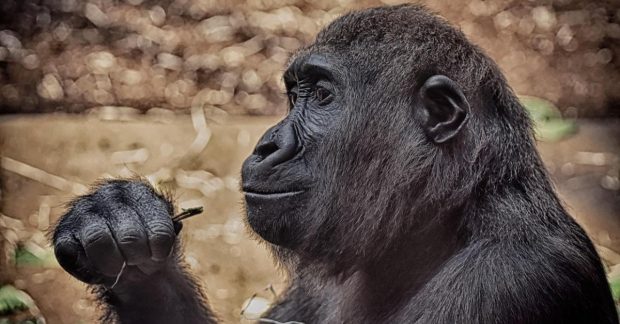
The wild animal kingdom regularly reveals discoveries that reshape our understanding of the cognitive abilities of our closest biological relatives. A recent scientific study has documented a rare example of conscious cooperation between two female western lowland gorillas at the Ramat Gan Safari Park near Tel Aviv. The animals managed to coordinate their actions to obtain food from a previously unreachable height.
The mechanics of unusual partnership and voluntary assistance
According to observations published in the journal Primates, females named Amelia and Lisha repeatedly demonstrated synchronized actions in 2021, 2024, and 2025. Researchers most thoroughly documented an episode where Amelia climbed onto a rock, and her half-sister Lisha firmly stood on all fours beneath the tree. Using Lisha's back as support, Amelia was able to reach a branch with leaves and bark at a height of about 4.5 meters, which was otherwise protected by an electric barrier.
Scientists paid particular attention to an incident recorded in June 2025. During this event, Lisha independently approached her sister and turned her back, showing readiness to help without any physical coercion from Amelia. This indicates the voluntary nature of the process and an awareness of a shared goal.
«Lisha was not just a stepping stone for Amelia&», noted biological anthropology PhD student Michael Levinsky, emphasizing the animal's active participation.
Although the gorillas spend little time together and sleep in separate quarters, their partnership proved remarkably effective. Researchers note that joint foraging did not always guarantee equal distribution—sometimes only one animal fed, highlighting the complexity of their social interactions.
Source UNIAN — unian.ua/science/gorili-znayshli-sposib-distati-jizhu-z-visoti-chom… ↗
Read next
 🏛️Politics
Seven EU Countries Urge Immediate Visa Ban for Russian and Belarusian Athletes
Leaders of seven Nordic and Eastern EU nations have called on top EU officials to immediately stop issuing visas to Russian and Belarusian athletes, preventing Russia fro…
 🎓Education
NASA study: how space radiation affects astronauts' brains
NASA researchers have discovered that prolonged exposure to space radiation alters brain immune cells, though it does not cause immediate behavioral impairments.
 🏛️Politics
Appeals court upholds detention of woman posing as paramedic during military facility blockade
The Kyiv Court of Appeal has rejected an appeal from a woman suspected of obstructing the National Guard, keeping her in custody without bail.
 🛡️Security
Humanitarian crisis on the Kinburn Peninsula: residents trapped without food and medicine
Around 100 civilians on the Kinburn Peninsula are facing a humanitarian disaster, trapped by mining and occupation forces without access to essential supplies.
 💡Tech
Study: Newest Artificial Intelligence Models Start Using Profanity in Internal Reasoning
An analysis by Vast reveals that language models trained after July 2026 increasingly use profanity in hidden reasoning chains when hitting a dead end.
 🛡️Security
Norway Discusses Regional Stability with Ukraine Following Baltic Sea Incidents
The Norwegian Defense Minister announced a constructive dialogue with Kyiv regarding security and stability amidst recent attacks on Russian vessels in the Baltic Sea.